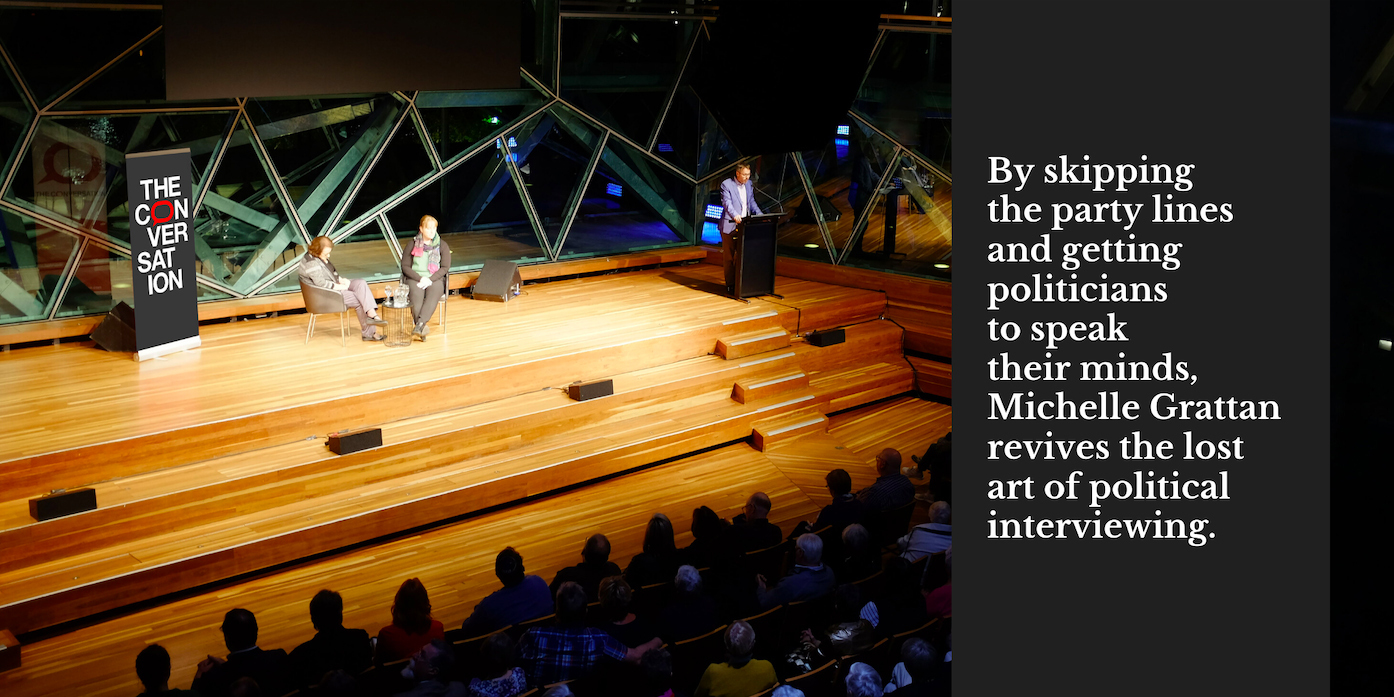
Michelle Grattan, Chief Political Correspondent at The Conversation, talks politics with politicians and experts, from Capital Hill.
Episodes
Apr 27, 2016
Apr 27, 2016
29 min
The future of Senator Robert Simms, one of the freshest faces in the Greens team, may hang on whether he is first or second on his party’s ticket. In his home state of South Australia, where the Nick Xenophon Team looks to be strong, the Greens face a particularly tough battle.
But Simms tells Michelle Grattan he thinks the Greens have a chance of retaining their two seats.
“There’s no question it’s going to be a lot of work for us in South Australia but I do think we can do it,” he says.
He also discusses the appeal of the Greens' to new groups of voters.
“I think one of the really good things about the Greens and our evolution as a political party is that we’ve really smashed that dichotomy that used to exist between the environment and the economy,
“We’ve really been able to say that what is good for the environment is good for the economy,” he says.
Apr 20, 2016
Apr 20, 2016
25 min
In 2015, the ABC aired a gripping documentary series covering the tumultuous Rudd-Gillard era. This week, the series’ writer and interviewer Sarah Ferguson has released a book developed from the documentary.
Ferguson tells Michelle Grattan she longed for a single villain or a single narrative that she could pursue to the ends of the earth.
The widely acclaimed journalist talks about the difficulties of getting past the defensive mechanisms of Kevin Rudd and Julia Gillard, both expert media operators, during her interviews.
“What nobody is prepared for is what happens over hours and hours of interviews. As we know, our politicians are highly trained in answering, not answering questions. Delivering messages, delivering lines. But none of them are prepared for what happens over ten hours,” she says.
“You can’t consistently tell a story that is not entirely true or is a version of a story or is shaped to suit you over a long period of time. Eventually inconsistencies, if there are any, will creep in. You can’t maintain the facade you use in a studio interview over ten hours.”
Ferguson also discusses Bill Shorten’s reluctance to participate in the documentary and to keep himself out of the story.
“He just wants to step away from the centre of the events and remain in the cloisters, underneath the arch, half in shadow,” she says.
Apr 19, 2016
Apr 19, 2016
32 min
In his ministerial reshuffle earlier this year, Malcolm Turnbull made Angus Taylor, an up-and-coming Liberal MP, the assistant minister for cities and digital transformation.
Taylor tells Michelle Grattan there needs to be agreement across all three levels of government to meet the challenges of jobs growth, transport and housing affordability faced by the nation’s cities.
“We have already said we’re going to use the mechanism of “city deals”, which is an agreement across federal, state and local governments on a strategy for each of our individual cities, recognising that no two solutions will be the same.”
Taylor also says Australia will need to find “innovative ways of financing increased investment in our cities”.
“We won’t be able to finance the very significant investments required in our cities just on budget. We’ll have to look off the budget. We’ll have to look to use our balance sheet,” he says.
Apr 13, 2016
Apr 13, 2016
28 min
Malcolm Turnbull will visit China this week in his first trip there as Prime Minister. The two-day trip, including Shanghai and Beijing, will juggle trade and political issues. ANU Professor of Strategic Studies Hugh White tells Michelle Grattan that Turnbull will be primarily focused on the economic agenda.
“Turnbull is one of those who remain bullish about China. He thinks its economic prospects remain bright and he sees it as the principal source of economic opportunities for Australia over the next few years and indeed decades,” White says.
White believes Turnbull is downplaying the strategic challenges Australia faces in its relationship with China in an era in which US primacy will no longer remain uncontested.
“If we want to remain a military middle power in an Asian century, in which we can no longer assume that the Americans are going to be the dominant player, then we are going to have to spend a higher proportion of our GDP on defence than we have,” he says.
He suggests defence spending needs to rise to 3.5% - 4% of GDP. At present it is just under 2%.
Apr 7, 2016
Apr 7, 2016
29 min
The global scandal surrounding the release of the Panama papers and Malcolm Turnbull’s criticism of Australian banks have put the spotlight on the often murky world of banking and finance. Greens' finance spokesman Peter Whish-Wilson, who had a pre-parliamentary career on Wall Street, tells Michelle Grattan one reason he walked away from the banking industry was because of its culture.
“You’re only as good as your last sale. I think the culture of any organisation starts at the top and the way they incentivise their employees – from the CEO down – is the root cause of the problem,” he says.
Whish-Wilson argues that a royal commission into the finance and banking sector is what is needed to deal with its pervasive cultural problems. He also says the Australian Securities and Investments Commission and the Australian Tax Office need greater powers to deal with the tax-avoiding behaviour revealed by the release of the Panama papers.
Apr 6, 2016
Apr 6, 2016
19 min
Senators will return to Canberra later this month with the expectation that they will give final consideration to the government’s industrial legislation - unless they decide to refuse to consider it. Glenn Lazarus, a crossbencher whose approval the government may need if the bills are to have any hope of passing, tells Michelle Grattan he will not be bullied or blackmailed into giving his support.
Lazarus says that when he asked Malcolm Turnbull to turn the Australian Building and Construction Commission into a national corruption watchdog for all industries, the Prime Minister gave him a blank look.
The former Palmer United Party senator also says that he has become a better politician as a result of leaving the PUP and that no ministers had visited his office before his decision to walk away from the party.