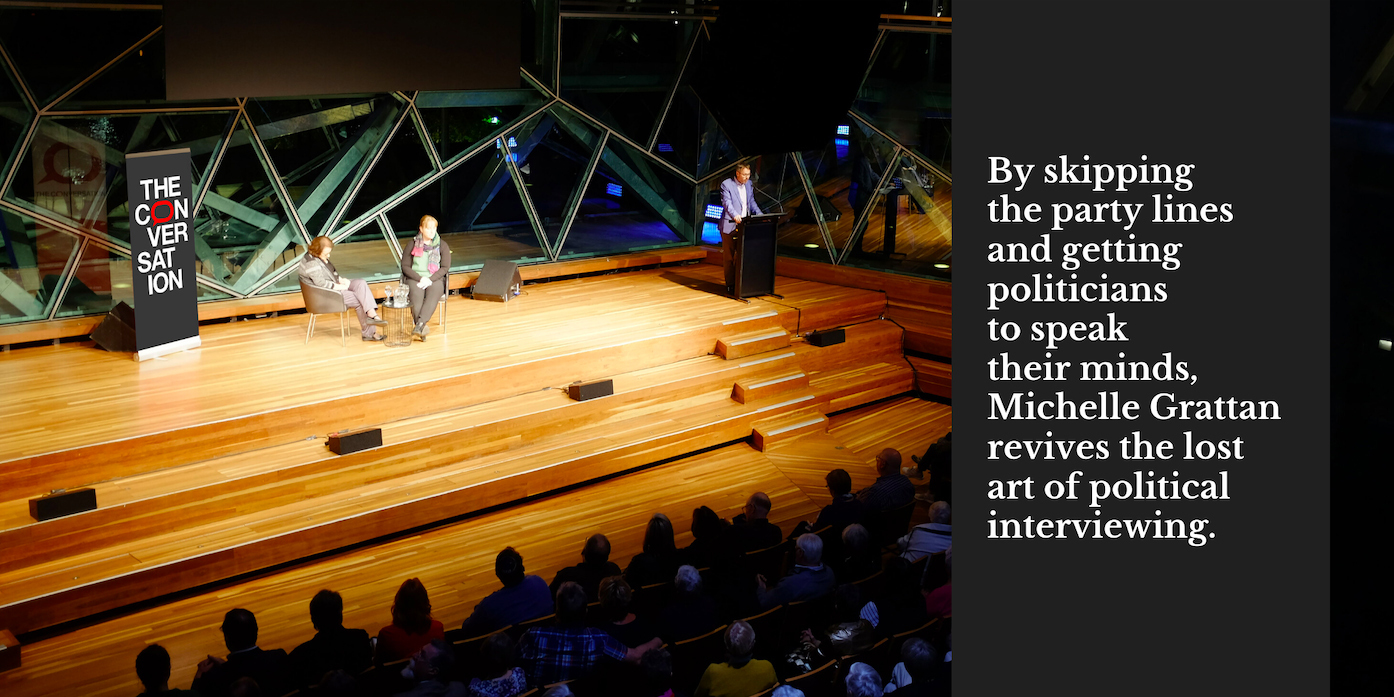
Michelle Grattan, Chief Political Correspondent at The Conversation, talks politics with politicians and experts, from Capital Hill.
Episodes
Nov 30, 2016
Nov 30, 2016
26 min
After ratifying the Paris agreement on climate change, the government is looking ahead to its 2017 review of climate change policy. Energy and Environment Minister Josh Frydenberg tells Michelle Grattan the government will have more to say about the review before Christmas.
“The key is to ensure we’re on track to meet our 2030 targets, which is a 26-28% reduction in our emissions by 2030 on 2005 levels. We did beat our first Kyoto target by 128 million and we’re on track to beat our 2020 target by 78 million tonnes. But clearly the 2030 target is a larger one and a more challenging one,” Frydenberg says.
“We’ve got some good mechanisms in place but we’ll be looking at the overall settings to ensure we meet our Paris commitments.”
With some in the Coalition rattled by the growing popularity of One Nation, Frydenberg says: “The way to deal with it is to listen and to understand people’s concerns as to why they have left some of the major parties and to take action to ensure that they understand the good things that the government is doing.”
Music credit: “Where the river run”, by Ketsa on the Free Music Archive
Nov 24, 2016
Nov 24, 2016
28 min
In times of budgetary constraint, the cost of Australia’s welfare system has been regarded by many in the Coalition as a burden and a drag on economic growth. Shadow Minister for Social Services and Families Jenny Macklin has a different take.
“Sadly I think the Liberal-National Coalition have an ideological view that the welfare system is too generous - even though the international evidence is completely to the contrary…our social security system is one of the most tightly targeted in the world,” she says.
For Labor, the message is that cuts to welfare and social services increases inequality - damaging the wider economy.
“You’ve got the International Monetary Fund, the OECD, other very big international players telling us that increasing inequality is a constraint on growth. So what Labor is saying is that we want to… use all the different levers available to us to reduce inequality through the tax changes on negative gearing for example, through improved social investments, such as our schools policy.
"These are all very practical policies that Labor has to reduce inequality, to make sure that we see that reduction in inequality delivering in improved economic growth.”
Music credit: “Dryness”, by Ketsa on the Free Music Archive.
Nov 23, 2016
Nov 23, 2016
23 min
Earlier this week, footage aired of Attorney-General George Brandis speculating that Queensland’s Liberal National Party might demerge. But Nationals leader and Deputy Prime Minister Barnaby Joyce says this won’t happen.
“It’s not going to happen. You know why? Because the people who make that decision is not George, or myself or anybody else, it’s the membership and the membership would have to decide they want to do it and I haven’t heard any big swathes of members having meetings saying that want to demerge.”
Joyce tells Michelle Grattan the Nationals need to differentiate themselves from the Liberals.
“I think people clearly understand there’s a difference between the National Party and the Liberal Party. They recognise the qualities in both. If there wasn’t a reason to differentiate then you would amalgamate. So I’m very - always have been - parochially National.
"When I first came into politics back in 2005 and we got down to 12 members and senators I think, there was always this ‘oh we should just fold this show up’ and I fought as hard as I could with others to make sure that didn’t happen,” Joyce says.
Acknowledging the threat posed by One Nation, Joyce puts that party’s success into the context of a global wave of right-wing populism.
“In those messages are things that matter to people - are messages that matter, that resonate. People wouldn’t just change [their vote] because they got a giggle. They change because they get a message and go ‘yep, that’s all I needed to know and that’s enough for me to change my vote’. And that’s what’s happening now and we’ve got to compete in that space.”
Joyce also has a reality-check for his colleagues pushing for changes to section 18C of the Racial Discrimination Act.
“There’s a set of people who are more intensely involved in politics and they might be concerned - but if you think I go past the guys working on the road and as I say ‘g'day’ to them and ask them how’s the job going [that] they’d say ‘I really want to talk to you about 18C’ - no they don’t.
"They are interested in the things they can touch. They do not occupy themselves in the deeper philosophical thoughts.
"What we’ve got to be really careful of is once you leave the party room meeting - whether it’s here or whether it’s your branch meeting back in the country - don’t think that’s the issue that’s going to get across to people in the pub on a Friday night.”
Music credit: “What tomorrow brings”, by Ketsa on the Free Music Archive
Nov 16, 2016
Nov 16, 2016
23 min
For allies of the United States, the reality of a Donald Trump presidency has just begun to sink in. Former Australian diplomat and intelligence analyst, Professor Rory Medcalf, who heads the National Security College at ANU, tells Michelle Grattan that for Australia, the shock of the Trump presidency will mean that we have to think much more seriously about what our foreign policy and national security looks like with an unpredictable American ally.
“I do think that Australia knows now that we can’t simply rely on the strategic direction that America is setting in the Asia-Pacific or the Indo-Pacific region, because I suspect under Trump, for quite a while, the Americans won’t know that themselves,” he says.
“A lot of old certainties are now in question. I think that countries like China and Russia are going to feel emboldened, particularly Russia. I think US allies around the world are going to be feeling anxious and there is this potential for a ripple effect of far-right political views, more so in Europe than in this country.”
Music credit: “Sabre”, by Ketsa on the Free Music Archive
Nov 8, 2016
Nov 8, 2016
23 min
Many in the government have clamoured for changes to be made to section 18C of the Racial Discrimination Act. Liberal backbencher Julian Leeser, however is not one of them.
The member for the northern Sydney seat of Berowra tells Michelle Grattan there are definitely people within the Liberal Party who share his view that Section 18C “achieves a good balance between allowing people the freedom of speech which is necessary in a democracy like Australia but also protecting racial minorities from racial vilification and racial slurs”.
“But the thing that I think unites everybody in this debate, regardless of your view on Section 18C, is that the process underscored in the QUT case and also in the Bill Leak case, just didn’t work as well as it should have,” Leeser says.
Nov 3, 2016
Nov 3, 2016
30 min
Kim Beazley’s time as Australia’s ambassador to the United States came to an end earlier this year, but he is riveted by next week’s presidential election.
“When I was the ambassador to Washington I just missed politics every day. In this year, I am missing the United States every day,” he says.
Beazley tells Michelle Grattan that “slightly, on balance” Hillary Clinton is more likely to win. “But the anger, the energy, in this campaign is within one group and that is with the white working class - mainly male but also female - who feel that America is being taken away from them,” he says.
“I see the election contest at the moment has the momentum with Trump.”
He cites the reduced turnout of Democrat-voting African-Americans and the mire of the Hillary Clinton email controversy as factors in a possible upset.
“One would have to say that if there is more of this over the weekend that the Trump momentum may well be unstoppable.”
If Trump pulls off an unlikely victory, Beazley foresees huge challenges for Australia. “Were he to implement the policies that he talks about in regards to the Asian region, we would be confronting strategic damage and possibly economic disaster,” he says.
Beazley says Hillary Clinton has a very favourable view towards Australia. “She sees us as a skilled, well-off and purposeful people and she will have things for our will and purpose and a lot of them may well involve decisions or topics that we’re quite uncomfortable with.”
“I think for starters she would be looking very strongly at a deeper integration of Australian and American forces in the region. She might be looking more vigorously than Obama has been at deployment of American aircraft from Australian bases and she’d in all probability look quite strongly at the possibility of rotating ships through [Royal Australian Navy base] Stirling.”
Music credit: “Star-spangled banner” by the United States Marine Band on the Free Music Archive