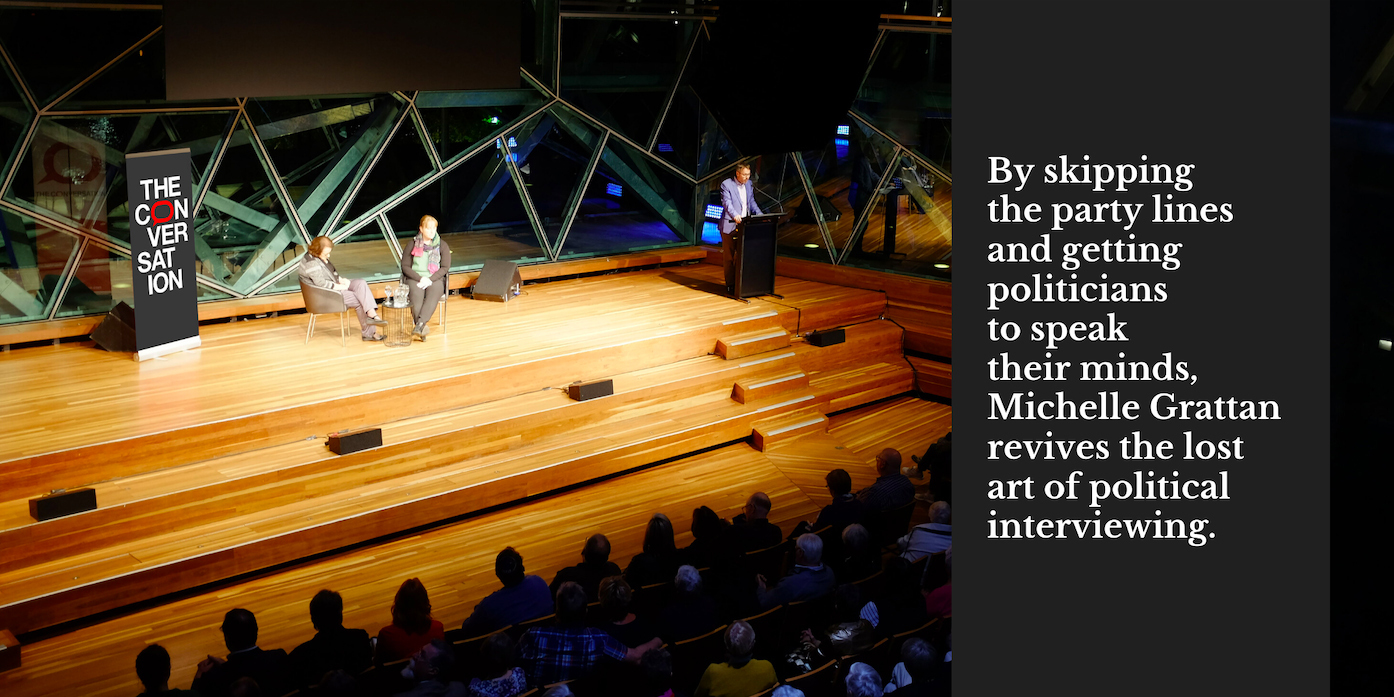
Michelle Grattan, Chief Political Correspondent at The Conversation, talks politics with politicians and experts, from Capital Hill.
Episodes
Mar 28, 2017
Mar 28, 2017
25 min
In his latest Quarterly Essay, journalist David Marr delves into why Pauline Hanson attracts so much attention. Looking at figures from the last election, Marr also paints a portrait of those voting for One Nation.
“The principal characteristics of her followers are this: they’re white, they’re at least third-generation Australians, they are – unlike most Australians – pessimistic about their own prospects and about the economic prospects of the country. This is a very optimistic country.
"They’re not all old. About one-third of the people who voted for her in the last election were under 45. They mostly didn’t finish school. That didn’t mean their lives were wrecked; they went on to get other qualifications.
"They are, above all, hostile to immigration. That is the most dramatic thing about them.”
Marr says the fear of Islam is at the centre of Hanson’s appeal. “If people are not recognising this, they’re just not facing facts,” he says.
As to Hanson’s “star” political status: “Whether she can survive a six-year term as a senator with this kind of lustre is a big question about her – because, on the whole, she doesn’t benefit much from prolonged scrutiny – prolonged scrutiny in the political process.”
Mar 23, 2017
Mar 23, 2017
21 min
The government this week introduced a bill that aims to put a stop to secret agreements between employers and unions without the knowledge of union members. The next hurdle will be the Senate, although it’s possible Labor may support the legislation.
Employment Minister Michaelia Cash says she is always in discussion with the Senate crossbenchers about the implementation of the recommendations from the Heydon royal commission.
“And certainly, I’m always willing to sit down with [Shadow Employment Minister] Brendan O'Connor or Richard Di Natale to discuss the legislation.”
Beyond these new measures, Cash suggests the government wants to legislate more recommendations from the royal commission into trade unions.
“There are about 50 to 55 left and we are finalising that package as we speak. We are absolutely committed to adopting the Heydon recommendations.
"There are further recommendations in relation to what employers and unions should be disclosing in the course of enterprise agreements. There are some recommendations which go to, for example, choice of superannuation fund in enterprise agreements. There are some recommendations which go towards further transparency. Again, we’re happy to adopt them all.”
Following a ruling by the Fair Work Commission to cut Sunday penalty rates in industries such as hospitality, retail and fast food, some businesses have been reluctant to show strong support for the changes. Cash would like to see more businesses take up the cause.
“I believe that if you accept a decision and you embrace the positive benefits and you want to bring people with you, then yes, you should be out there selling that message.
"These guys are scared. They are scared that the unions will come and get them.”
Mar 15, 2017
Mar 15, 2017
22 min
Greens leader Richard Di Natale is calling for a re-imagining of the way Australians approach work. “What we’re saying is: let’s have a look at some of the models around the world,” he says.
“It’s absolutely possible, as we’ve seen in places like Sweden, where in the aged care sector people are working a six-hour day rather than an eight-hour day, but they’re actually delivering a productivity dividend. They’re happier. They’re healthier at work. They’re actually producing just as much as they would be doing in an eight-hour day.”
With the future likely to see many jobs lost to automation, The Greens are keeping an open mind to the notion of “guaranteed adequate incomes”.
“It’s a system that gives people a wage, irrespective of income. It’s not actually means tested.
"It makes sure that everybody’s got enough to live on. There are a whole range of benefits to the economy. There are few overheads in administering it. So we’re looking … at the trials. We’re watching them very closely in Canada, in Scotland, in France and so on.”
In the wake of an energy crisis, both the federal and South Australian governments are placing a renewed focus on gas in Australia’s energy mix. But Di Natale says we’re having a debate that “belongs in the last century”.
“We shouldn’t be spending a cent on new gas infrastructure. We’ve got some legacy issues with existing gas plants and obviously existing coal-fired power plants. We’ve got to have a transition plan to make sure we can transition away from old, polluting energy generation to new renewable, clean-green generation. That’s the plan that needs to be put in place.”
Mar 9, 2017
Mar 9, 2017
29 min
The end of the mining boom has hit many people in Western Australia hard, and this has flowed strongly into the election. Debt and deficit are besetting the state budget. In this final podcast from Perth, we talk to economist Alan Duncan about the challenges for the state’s economy and for whoever forms government after Saturday, as WA undertakes a vast transition.
We also interview Opposition Leader Mark McGowan, who goes into the election as favourite. McGowan had much-revered Labor figure Bob Hawke over to help last week. Hawke talked to him about his summit approach to economic policy-making after he was elected prime minister in 1983. McGowan tells us he wants to be a consensus premier locally, but when he ventured out of his state he would be fighting hard for the interests of WA.
“As a West Australian you put forward a robust case on behalf of your state. We never seem to get any favours out of the Commonwealth. And what we have to do is be absolutely forceful and never, ever give in. And I think that’s the way to treat the federal government - whoever they are,” McGowan says.
If he becomes premier, McGowan would face a hostile upper house, with One Nation holding all or part of the balance-of-power.
“The way you deal with the upper house, in my experience as a former minister, is you present good legislation and you argue the case. There’s no easy solutions when you have a hostile upper house.”
“I would just hope that One Nation, if they get elected, look at the merits of legislation that comes before them.”
Mar 9, 2017
Mar 9, 2017
52 min
In our second podcast from the Western Australian election, we talk to Kim Beazley, especially about One Nation. Beazley was federal Labor leader during Pauline Hanson’s first political phase. He sees her as a national security threat and believes she should be opposed in the strongest terms.
“We [in WA] are probably more conscious of South-East Asia. We do more trade with South-East Asia … with Indonesia for example. There’s a strong propensity here to look very seriously at Indonesia. Lots of West Australians holiday in Indonesia. … The positions she is adopting pose to seriously damage a critical security and economic relationship. I think quite a lot of West Australians understand that,” he said.
“The rise of One Nation, to my mind, ought to be greeted in much the same way as we greeted [Hanson] back then - to see it disappear as quickly as possible.”
In this podcast, we also visited Rockingham, south of Perth, where we found mixed views about One Nation and more than a little general disillusionment. Polling analyst William Bowe, who’s been watching the One Nation phenomenon, says their campaign has been “a bit of a shambles”. “I guess the question in this election with respect to how well they’re going to go is: how much does that matter?”
“Given the sort of experience of Donald Trump’s campaign last year, I think there’s an idea that these sorts of populist movements can get away with a great deal.”
Finally, Dexter Davies, federal senior vice-president of the Nationals and a former WA state MP, strongly defends the controversial Nationals’ proposal for a mining tax on Rio Tinto and BHP, which has triggered a massive campaign from the mining companies.
Mar 7, 2017
Mar 7, 2017
29 min
In the first of three Conversation podcasts on the Western Australian election, we talk to Natalie Mast at the University of Western Australia, Premier Colin Barnett and ABC election analyst Antony Green.
Saturday’s election potentially carries a hefty national punch.
The polls are running strongly against the Liberal government. If Colin Barnett loses, the federal Liberals will become even more jittery, although the defeat would be due primarily to state factors.
The election will also test the power of Pauline Hanson’s One Nation as a disruptor, with the party set to win state upper house seats. Hanson is on the campaign trail all this week. Her latest provocative comments on immunisation, Vladimir Putin and Muslims - she said on Monday Muslims had changed Australian suburbs - continue to highlight the dubious deal the WA Liberals have done with One Nation on preferences.
The deal has alienated some among both Liberal and One Nation supporters. Barnett is anxious to keep maximum distance from Hanson, insisting the preference swap doesn’t indicate any wider convergence.
He admits that while some people will be unhappy with the deal, “I think overall it will improve the Liberal Party vote. And can I stress there’s no agreement with One Nation. I don’t endorse their policies. I don’t endorse their candidates and there is no agreement about any role in government about legislation or policy.”
 ABC election analyst Antony Green. Pat Hutchens/TC
Barnett, who is promising - ambitiously, given the government’s unpopularity - to sell 51% of Western Power, is highly critical of the way the national energy debate has gone.
After saying at a news conference on Tuesday there was no such thing as clean coal, Barnett told The Conversation: “Coal has relatively high levels of emissions. Higher quality coal tends to have lower emissions per unit of energy produced. In Western Australia we have had good long-term policies on natural gas and for a power station of an equivalent size, gas powered generation produces less than half of the emissions of coal. So if you want to clean up the energy system in Australia, it seems to me that the bleeding obvious thing to do is to make more use of natural gas in Australia,” he said.
He says he watches “with bewilderment” the national debate on energy policy. “Australia, with its huge natural resources of coal, of natural gas, of uranium and so on, has got itself into an absolute mess over energy policy.”