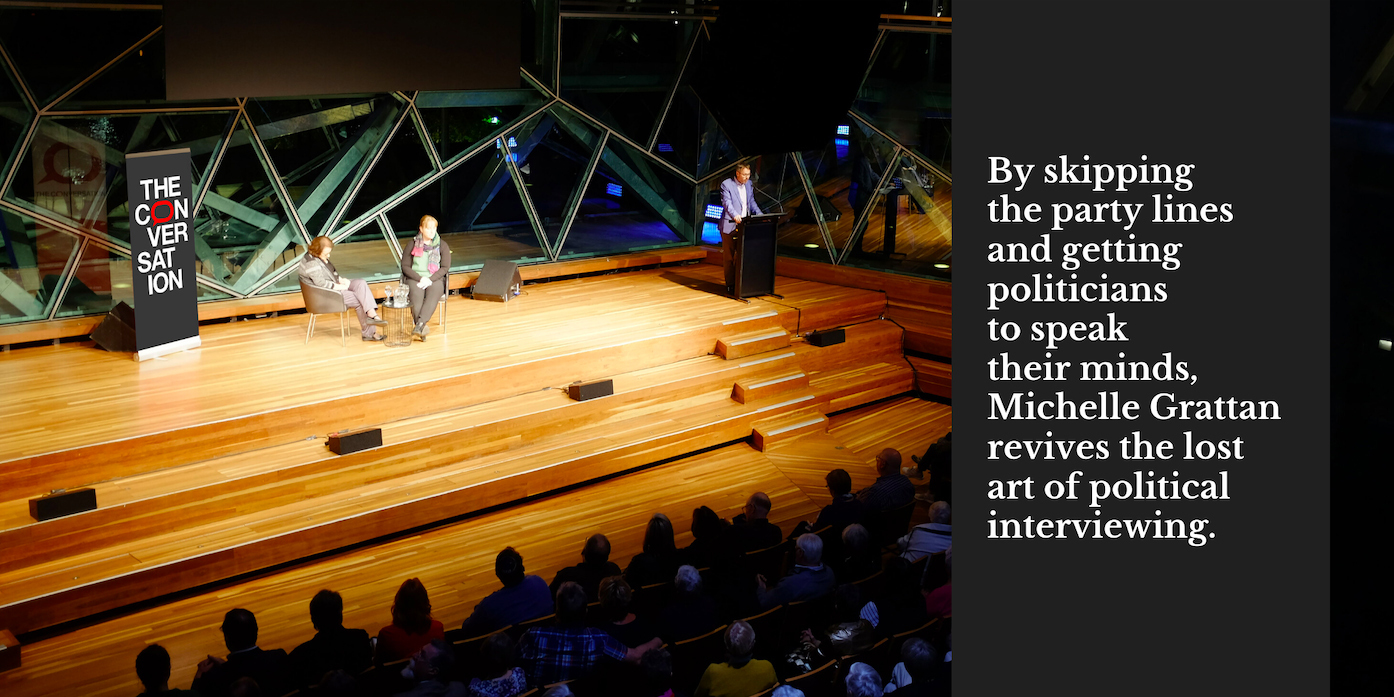
Michelle Grattan, Chief Political Correspondent at The Conversation, talks politics with politicians and experts, from Capital Hill.
Episodes
Jun 1, 2017
Jun 1, 2017
27 min
The Coalition has backed the Adani Carmichael coal mine but there’s debate about assistance for the project, and argument about the jobs it would create in the region.
Matt Canavan argues there’s a role for the government to invest in large scale infrastructure. He tells The Conversation this mine is only one part of a plan for “opening up the Galilee Basin” to provide investment opportunities, exports, and employment. “This coal is not for Australia, it’s for our region.”
On last week’s Uluru statement calling for an Indigenous body to be enshrined in the constitution Canavan says he’s concerned about creating another organisation, especially if it were to be based on different racial definitions. He says options should be explored for greater recognition of Indigenous people in the political process without “necessarily making changes to the constitution”.
On the coming Queensland election - with polling close - he says either side’s for the taking. “The Queensland Labor government has had a pretty rough time in the last week but I pick up a lot of frustration in North Quensland and I think they’ve got a lot of work to pick up trust.”
May 25, 2017
May 25, 2017
38 min
Dennis Richardson, one of Australia’s most respected federal public servants, has just retired after an illustrious career. He served as head of the foreign affairs department, the defence department, and ASIO, and was Australian ambassador in Washington. He was also once chief-of-staff to then-prime minister Bob Hawke.
Richardson was never afraid to tell ministers what he believed they should hear, and any grudges they had as a result they apparently got over very quickly.
He urges bureaucrats to be forthright with their political bosses, but also to be strategic in how they go about trying to persuade. “Providing frank and fearless advice is not about getting something off your chest, it’s about seeking to influence for an outcome that you think is the right one.”
In this interview with The Conversation he reflects on trends in the public service, and discusses the implications of the Trump presidency and the future of China. He also recalls as a very young public servant being sent to play squash with Billy McMahon – and beating him. Not long after, he handed out how-to-vote cards for Labor in the “It’s Time” election.
May 24, 2017
May 24, 2017
26 min
Labor has come under fire for some of its budget responses, including its opposition to the schools package, and only partial support for the Medicare levy increase.
Shadow treasurer Chris Bowen rejects the government’s argument about the schools plan being more “needs based” than present arrangements, telling The Conversation its “one-size fits all” approach will put pressure on families and the public system. “Being needs-based is a bit like being pregnant, isn’t it? You either are or you aren’t.”
Bowen defends targeting the Medicare levy rise only at higher income earners by saying Australia’s low wage growth and other factors mean the circumstances are different from when Julia Gillard raised the levy across the board.
Small and medium-sized businesses – with a turnover up to $50 million - are waiting to find out whether a Labor government would cancel their legislated tax cut. Labor is “taking a bit of time” before announcing its position, Bowen says, to look at “all the implications.” He’s commissioned work from the Parliamentary Budget Office. “There’s all sorts of stuff on the public record that I carefully sift through so that when I make a recommendation to shadow cabinet it’ll be a good one and a firm one and enable a good discussion.”
On the controversial Adani Carmichael coal mine, which is dividing Queensland Labor and is publicly opposed by several federal ALP MPs, Bowen stresses the project’s future must rest squarely on its own merits, without government subsidy. “If it stacks up, it stacks up.”
May 10, 2017
May 10, 2017
May 8, 2017
May 8, 2017
21 min
The shadow assistant minister for schools, Andrew Giles, says the strong opposition from Catholic schools to the government’s education package is because they were given “almost no notice” of the funding changes.
“What’s different in the Catholic system from the independent sector is the practice of making systemic decisions. And that’s something that has been fundamentally ignored by the minister in the manner in which this has been outlined.”
Giles says that “people will be waiting a long time … a lifetime” to see tangible resourcing outcomes from the government’s package.
As to other measures to tackle inequality in Australia, he says: “if we’re serious about tackling inequality we need to think really hard about taxes”.
A member of Labor’s left faction, Giles is an advocate of a Buffett rule, a proposal that would see high-income earners paying a mandated minimum rate of tax. However, this remains a side debate within the party at this stage.
Shadow Treasurer Chris Bowen has ruled out the idea for a Labor government, and says it wouldn’t be pushed at the ALP conference next year.
As Giles says: “The challenge for those in the more radical wing is to get the balance right between discipline and dissent.”
May 5, 2017
May 5, 2017
18 min
This week, the government made big announcements about the future funding of schools and universities. Haunted by the unpopular 2014 budget, it is treading more carefully with its new education policies.
Education Minister Simon Birmingham says one of the challenges of the 2014 budget was that there were “a lot of different pieces of policy reform all announced simultaneously”.
Birmingham - who took on the education portfolio after Christopher Pyne - is at pains to emphasise the government’s preparation this time around. “We’ve gone through, in university reform, a very methodical process - putting out a discussion paper before the last election that aired, if you like, all of the different options and scenarios very openly,” Birmingham says.
“In terms of schools funding - I’ve met with David Gonski, members of his panel, I’ve had numerous discussions with state and territory ministers, with independent and non-government Catholic school representatives.”
May 3, 2017
May 3, 2017
18 min
Professor John Hewson, a former Liberal leader and chair in the Tax and Transfer Policy Institute at the Australian National University, describes the uncertain economic climate into which Treasurer Scott Morrison will deliver next week's budget.
"I think it's an occupational hazard for treasurers that they're always optimistic - always try to put a better gloss than is the case," Hewson says.
"I've been analysing and forecasting economies since the late '60s and I picked up most of the big turning points over that period, but I'd have to say that right now I think it's harder than it's ever been to say what might happen next."
Hewson nominates the after-effects of the global financial crisis, geo-political tensions and environmental challenges as some of the factors driving his doubt.
There is also the matter of Donald Trump.
"He's quite unpredictable and his capacity to govern in the United States is really quite limited. Although he might have been a reasonably succesful property developer, it's not easy to run a government off that skill set in Washington and he's finding the reality of that."
___
_This podcast is co-published with the University of Canberra's [Institute for Governance and Policy Analysis](http://www.ausbudget.org/)_